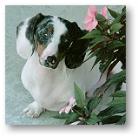
What is a Dapple?
Dapple is a pattern seen
in Dachshunds. It is commonly referred to as "Merle" in
other breeds of dogs (Collie, Sheltie, Great Dane, Australian
Shepherd).
It is important to understand that dapple
is NOT a color, it is a pattern. Dappling can be
compared to painting a room in your house. Say you paint the room
green. Before the paint is allowed to dry, you dip a sponge in white
paint and then dab the walls with the sponge. For each spot that the
sponge touches, you will have a lighter green marbling affect that results
from the green and white paint blending together. Dapple works in
precisely the same fashion. The dappling can occur on any color.
A dappled black & tan Dachshund would leave a black base with a gray
marbling affect. A dappled red Dachshund would result in a pinkish
marbling affect. A dappled chocolate & tan Dachshund would create
a cream marbling effect.
Precisely where the dappling chooses to
occur is anyone's guess. In one litter of puppies, you can have
puppies that are dappled from nose to tail or you can have puppies with
nothing more than a dapple splotch on the top of the head. A well
dappled puppy can go on to produce lightly dappled puppies, just as a
lightly dappled puppy has an equal chance of producing heavily dappled
puppies. There is never rhyme nor reason to how the dapple chooses to
act on a puppy. There are responsible breeders who have worked to
understand the gene and how it works. They've also put much into
their program to produce healthy dogs, but, these breeders are far and few
between. Puppy mills, pet shops and sadly, the Internet have
capitalized on unsuspecting people and jeopardized many healthy dogs.
How does it work?
Many breeds of dogs come
in a variety of colors and patterns. But no breed is as diversified
as the Dachshund. There are many acceptable colors and patterns of
Doxies, as well as three acceptable hair coats and two sizes. While
most people are familiar with the red and the black & tan Dachshunds,
it is interesting to note that there are nearly 300 varieties of
Dachshunds.
Dapple, as I mentioned earlier, is a
pattern. When two Doxies breed, they both contribute to each puppy's
gene pool. Have you ever played the card game "War"?
In the card game both players are dealt an equal amount of
cards. Player 'one' flips one card over and Player 'two' flips
one card over. The player with the highest value card takes both
cards and puts them in their pile. The game continues on until there
are no cards left in either player's hand. You can compare the
genetic make-up of a puppy to a game of "War". The dam
flips over one gene*, and then the sire flips over one gene. The
'higher' valued gene (dominant) goes into the winner's pile. The
'lower' valued gene (recessive) goes into the the loser's pile.
When the game is over, the dominant pile is made up of the genes that
contribute to the 'outside' of a puppy....those things that we see.
The recessive pile is made up of the genes that contribute to the 'inside'
of the puppy...those things we can't see. When that puppy is
old enough to breed, the dominant and recessive genes are shuffled and a
new game of 'War' begins.
In the card game, you can sometimes have
a tie, both players flip over the same card of equal value. This can
also happen with genes in a puppy. In the card game, 'War' is
declared and there is a 'showdown'. However dogs have never been
known to be as competitive as humans are...dogs simply call it a
draw. It's anyone's guess whose gene (the sire or dam) gets to go in
the winner's pile, but it is really irrelevant, since both genes are
identical.
There are thousands of genes involved in
the make-up of a dog, from the shape of his ears to the length of his
tail. There are approximately 300 known genes that contribute to coat
color/pattern in dogs. This article is not intended to give you a
crash course in genetics. I am simply trying to lead you into the
genetic make-up of a double dapple so that you can fully understand the
dangers.
The gene for dapple is dominant over the
gene for non dapple. As an example, we'll say that the sire flips
over the dapple gene and the dam flips over the non dapple gene. The
two genes are compared and the dapple gene goes into the winning pile...the
part you will see on the puppy. The non dapple gene will go into the
losing pile...the part you don't see on the puppy. Every time a
dapple gene is passed on to a puppy, that puppy will be dappled because a
dapple gene will always be dominant.
*Note: For those of you that are
familiar with genetics, I wanted to mention that many times the word 'Gene'
is used in place of the proper term, "Allele". I feel
that describing alleles will only confuse the average viewer and the point
can be made by substituting the word 'gene'.
What is a Double Dapple?
If both the sire and the
dam of a puppy are dappled, they both have an equal chance of passing on
their dominant dapple gene to the puppy. The sire may flip over the
dapple gene, and the dam may flip over the non dapple gene. In
this case, the sire's dapple gene would be dominant and that puppy would be
a dapple. This confuses a lot of people. How can a dapple dog
have a non dapple gene? It is easy to forget that every dog has a
winning pile...what you see on the outside, and a losing pile...the
recessive gene that is hidden. If each dog only had one gene to contribute,
there would never be variety in the dogs. When two dogs breed, the
recessive genes are shuffled with the dominant genes so that they have a
chance to manifest themselves. If the recessive gene meets up with
another recessive gene, it finally gets its chance to be in the winning
pile. However if the recessive gene again meets a dominant gene, it
has to wait another generation for the chance to dominate.
It is also possible for both the sire and
the dam to flip over their non dapple genes. If this is the
case, it becomes a 'draw' and the puppy is not dappled.
And finally, it is possible for both the
sire and dam to flip over their dapple genes. Again, it is a
draw, but something totally different happens. We'll say that the
sire's dapple gene gets to go in the winning pile. The puppy is now
dappled. But the dam also contributed a dominant dapple
gene. Her gene says, "Whoa, wait a minute buddy! What do
you think this is, the 19th century? I demand equal rights here!
I want a chance to dapple this puppy and the 19th Amendment guarantees me
that right!"
So the dam's dapple gene goes to work, after
the sire's gene has already made the puppy dapple. Since it's
anybody's guess as to where the dapple gene will hit (remember the sponge
painting in the first chapter?), the outcome will vary greatly. We'll
assume, for ease of understanding, that the sire dappled the tail, and
nothing more. The rest of the puppy was a normal color and
untouched by the dapple. The dam's gene is mad at almost missing out
on her chance, so she dapples the entire body...from head to tail.
The areas that the sire's dapple gene left untouched would now be dappled
by the dam's dapple gene. However, the area that the sire's gene did
dapple (the tail) would be dappled again.
Let's go back to the paint. You
finished the first coat of green and then finished sponging white paint
over the wet green paint. Now dip the sponge in the white paint
again. What do you think will happen when you start sponging the walls
again? The areas that did not get touched by the first sponging,
would now have the marbled look, but the areas that were marbled the first
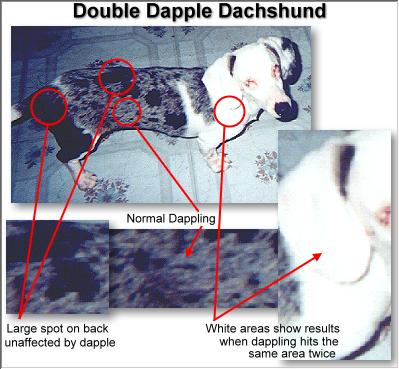
time would now appear totally white. This is precisely what happens
when the dapple gene is allowed to act twice on the same area. Look
at the picture below:
So, What's Wrong with a Double Dapple?
 For
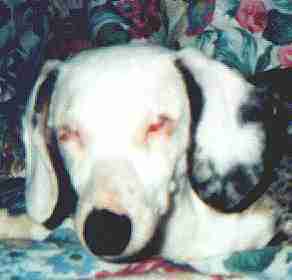
reasons unknown, the combination of two dapple genes hitting the same area
of the dog can be lethal. I have seen double dapple puppies born with
no eyes, and/or no ears. Blindness and/or deafness is also
caused by the double dapple gene. On the other hand, a double dapple
can be born with no deformities at all. For
reasons unknown, the combination of two dapple genes hitting the same area
of the dog can be lethal. I have seen double dapple puppies born with
no eyes, and/or no ears. Blindness and/or deafness is also
caused by the double dapple gene. On the other hand, a double dapple
can be born with no deformities at all.
There are no facts or figures available
(that I have found) that tells us how many dogs like this dog have been
whelped. The double dapple pattern is an acceptable pattern that is
recognized by AKC. In my opinion, if AKC continues to allow
this pattern (which can only be achieved by breeding two dapples together,
so it is totally preventable) to be recognized, then serious studies should
be done to look at the damage being done to the dogs. I, for one,
feel that even one dog like this is not worth the risk of a million healthy
dogs.
Why Would Anyone Do This?
For every deformed double
dapple, there is a different excuse. Here are a few of those 'excuses' and
a few solutions.
1. Simple ignorance: Genetics
are a complicated matter and many breeders won't even take the time to try
to learn.
Solution:
TAKE THE TIME TO LEARN! There are two foundation books on
genetics. Both are excellent books but both are out of
print. Try your local library!
"Genetics of the
Dog: Malcolm Willis"
" Inheritance of
Coat Color in Dog: Clarence Cook Little"
2. Genetic background
unknown: Although the only way to get a double dapple is to breed two
dapples together, there are many people that don't know they own a
dapple.
a. Red
dapples often fade as they get older. A Doxie that was poorly dappled
at birth, and is red it color, will probably not be recognized as a dapple
later in life.
Solution:
Don't breed reds to dapples. If you do, make sure you examine every
puppy from head to toe at birth. This is when the dappling is most
noticeable. Be sure to mark a puppy as a dapple, even if it has no
hint of dapple at eight weeks of age.
b. Other
colors of dapples are often so lightly dappled, they are not marked as
dapple on their papers.
Solution:
Again, be sure to record dapples at birth. A good sign of a
dapple (assuming one of the parents was a dapple) is if a puppy has any
blue flecks in the eyes. The dapple pattern can color the iris of the
eyes, just as it covers the color of the coat. When the dapple
pattern hits the iris, it turns it blue, like that of a Siberian
Husky. Since the dapple pattern is so sporadic, it can hit just a
spot on the eye, causing a normal color eye with a tiny blue
fleck. Always mark blue eyed or partial blue eyed pups as
dapples if there is even the slightest chance that it is a dapple.
3. Mistaking double dapples for
piebalds: This is the most aggravating of all the mistakes
made. Without getting into the genetics behind a piebald, I will tell
you that a piebald is a normal color Doxie with varying amounts of
white. A piebald does not have dapple. A piebald does not have
blue eyes, or partial blue eyes. A Piebald is normally marked
symmetrically...meaning that if one ear is black, the other ear is
black. If one paw is white, the other paw is white. If one side
of the face is white, the other side is equally white. A double
dapple is not symmetrical. You will often see one leg normal colored
and the other leg totally white. One side of the face can be white
and the other side dappled. These are the easiest way to tell if a
dog is double dappled or piebald.
Solution:
If you aren't sure if your dog is double dapple or piebald, look at the
pedigree! A double dapple will always have a dappled dam and a
dappled sire. A piebald can come from any color, but you will
normally see piebald in the background. Since piebald is recessive,
it is possible to have two plain black & tans produce a piebald.
However ONLY TWO DAPPLES can produce a double dapple. The ultimate test of
a double dapple is to breed it to a plain colored dog. If the
puppies are dapple, your dog is a double dapple!
Note: There is a lot of evidence of
people marking double dapples as piebalds. I was curious to see
what AKC had to say about it, so I called them and told them that I had a
litter of Doxie puppies and one of the puppies had a lot of white on
it. I was told that if the puppy had 50% or more white, to mark
it as a piebald. This is absolute INCORRECT and DANGEROUS
information! Use a combination of the info given to you here to
determine if your dog is a double dapple or a piebald.
4. For the show ring: There
is no doubt about it, a double dapple is stunning. The combination of
dappling and white is flashy and many breeders purposely breed dapple to
dapple in hopes of show prospects. If you know what you are doing; if
you know the risks; if you don't mind the chance of deformed puppies; then
"More Power to You."
Solution:
I'm left to do my best Forrest Gump impression and say "...and
that's all I got to say about that..."
5. Greed: If we go back to
the genetics behind a double dapple, you will remember that a double dapple
results when two dapples both contribute their dapple gene to one
puppy. That puppy, if he goes on to breed, will have two dapple genes
that will be shuffled and eventually dealt out into the gene pool.
Since the dapple gene is dominant, and the only thing that puppy has is a
dapple gene, there is a 100% chance that every, single puppy that dog
produces will be a dapple.
In other words, a double dapple will
ALWAYS produce dapple puppies, even when bred to a normal color dog (black
& tan, chocolate & tan, etc.). Since dapple puppies normally
command a higher price, there are breeders who purposely breed dapple to
dapple, in hopes of getting a double dapple. That double dapple can
then be used to produce all dapple puppies...all of his life. It is
interesting to note, that even a dog which is totally blind and deaf will
NEVER produce a deaf or blind puppy (providing that he isn't bred to
another dapple or carrying some other genetic defect that causes
deafness/blindness). The deafness/blindness seen in double dapples is
only a result of the two dapple genes.
Solution: There is no solution for
this sort of breeder. Greed is more powerful than compassion.
How Can I Help?
The double dapple
deformities are not seen just in Dachshunds. As I mentioned earlier,
the pattern (referred to as Merle) are seen in several other breeds of
dogs. In my experiences, when deafness and blindness are seen,
the dog is generally very well adjusted and very 'well adjusted'.
Which is so fortunate.
Getting the word our about irresponsible
breeding of dapples is important. Many of you are in large cities
where you have the ability to get the word out about the dangers of double
dapple breeding. Many of you attend dog shows regularly and can pass
out literature (feel free to print this article) to people at the
show. Something as simple as scanning the internet for breeders
selling double dapples (which are often listed at piebalds) and sending
them the link to this article, can go a long way to educate a lot of
people.
If you have the resources to provide a
loving home to a dog that is deaf and blind (even if it is for a breed
other than the Doxie), find Doxie, Aussie, Collie, Dane, etc. rescue groups
on the internet and volunteer to adopt or foster a handicapped double
dapple/merle. Don't adopt out of pity...it is a huge
undertaking to adopt one of these guys.
I hope this helps to clarify how the
double dapple gene
Back to Top
|