All about DOG SHOWS
Conformation Shows
Conformation Shows are those some people refer to as "the beauty shows". Dogs at conformation shows are judged as to how well these meet (or conform) to the standard of the breed. In the United States most shows are held under the auspicies of the American Kennel Club (AKC), hence the standard of the breed for the Dachshund is the AKC standard. Shows held out of the US may us the standard of that particular country or the FCI international standard.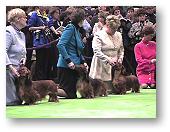 There
are two types of conformation shows: specialty and all-breed. All-breed
shows will have classes for all AKC registered breeds, while specialty
shows are just for a single breed or a group of similar breeds (for example
hound group dogs). The main consideration at a conformation show is the
overall appearance and structure of the dog as defined by the "Standard"
of the dog. During judging of the Dachshund each dog is to be examined
by a judge, and the judge ranks the dogs in accordance to how close the
dogs come to their own (the judge's) interpretation of what the perfect
dog looks like, based upon their reading of the standard. On any given
day, a dog can win or lose, depending on how the judge interprets the standard.
Copies of the standards are published in a book put out by the AKC called
The Complete Dog Book. Click
here to see how you would judge 6 dogs in the ring.
There
are two types of conformation shows: specialty and all-breed. All-breed
shows will have classes for all AKC registered breeds, while specialty
shows are just for a single breed or a group of similar breeds (for example
hound group dogs). The main consideration at a conformation show is the
overall appearance and structure of the dog as defined by the "Standard"
of the dog. During judging of the Dachshund each dog is to be examined
by a judge, and the judge ranks the dogs in accordance to how close the
dogs come to their own (the judge's) interpretation of what the perfect
dog looks like, based upon their reading of the standard. On any given
day, a dog can win or lose, depending on how the judge interprets the standard.
Copies of the standards are published in a book put out by the AKC called
The Complete Dog Book. Click
here to see how you would judge 6 dogs in the ring.
Judges are people who have studied the breed and have a great deal of knowledge about the breeds they judge. There is a test and interviews as well as years of experience in a breed a judge must demonstrate before they are certified by the AKC to judge. The dogs are each shown to the judge in the same manner. They are moved at a trot so that the judge can evaluate how well the dog is structurally built while in action. The Dachshund is also "stacked" on an examination table to allow the judge to examine or "go over" each dog with their hands. The judge looks at such things as teeth and bite, muscularity of the dog, coat texture and length, as well as looking for the proper size, proportion and structure in each dog.
Dog Show Classes
 Dog
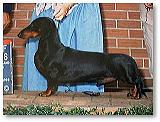
shows are a process of elimination - you start the day out with about a
thousand to two thousand dogs , and the last dog to win at the show is
considered the best and is called the Best In Show winner.
Dog
shows are a process of elimination - you start the day out with about a
thousand to two thousand dogs , and the last dog to win at the show is
considered the best and is called the Best In Show winner.
When the show starts, the competition begins at the breed level - only dogs of the same breed compete against each other. There are different regular classes in which dogs may be entered. You would normally see the following classes in each breed, and they are separated for for male and female dogs:
Each of these classes is judged separately, with all of the classes for the males (or "dogs") being judged first. The assistant ringside (ring steward) will call for "Puppy Dog number 7," or "Puppy Bitch number 6" for example. At many shows, there will be only one or two dogs in each class. When each class has been judges each dog that won first place returns to the ring to compete again. From this group the judges will pick the WINNERS DOG. After the dogs have been judged, then the process is repeated for the female dogs ("bitches"). Only the one dog considered to be best male (WINNERS DOG) and the one female considered to be best female (WINNERS BITCH) receive championship points.After the judge has selected WINNERS DOG or WINNERS BITCH they will select the second ranking of the group -- this award is know as RESERVE. Following judging for the dogs and bitches the judge will then judge the BEST OF BREED CLASS. This class determines the one single representative of the breed that will go on to compete further that day. In the Best of Breed Class the Winners Dog and Winners Bitch also compete with the champions for the title of Best of Breed.
In the Best of Breed Competition, three awards are given
AKC Groups and Group Competition
BEST OF BREED - the single dog judged as the best representative of the breed that day.BEST OF WINNERS - the dog that the judge considers the best of the two class winners: Winners Dog and Winners Bitch.
BEST OF OPPOSITE SEX - the best representative of the breed that is the opposite sex of the Best of Breed winner.
 The only dog that continues to represent the breed after breed competition
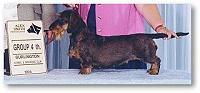
is the winner of the Best of Breed award. The Best of Breed winner goes
on to compete at the group level.
The only dog that continues to represent the breed after breed competition
is the winner of the Best of Breed award. The Best of Breed winner goes
on to compete at the group level.
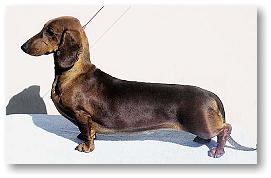
Each AKC-recognized breed falls into one of seven group classifications. While four placements are awarded in each group (Group I, Group II, Group III, and Group IV), only the first place winner will advance to compete in the Best In Show competition.
THE SEVEN GROUPS IN AKC ALL-BREED SHOWS (a full up to date listings of the breeds in each group may be found on the AKC Web Site):
- SPORTING - Dogs that were bred to hunt birds both on land and in the water. The breeds in this group include the Pointers, Retrievers, Setters and Spaniels
- HOUNDS - Dogs that were bred for hunting other game, either by sight (sighthounds or gazehounds) or by scent. These breeds include such dogs as Afghans, Beagles, Bassets, Dachshunds and Greyhounds.
- WORKING - Dogs that had specific jobs. Some were used to pull carts, or to guard property, for swimming, or for tracking. Among the breeds in this group are the Akita, the Boxer, the Doberman Pinscher and the St. Bernard. Also included in this group are the flock protector breeds, such as the Great Pyrennes and the Kuvasz.
- TERRIER - This group includes the largest number of breeds, mostly designed to hunt and kill small to medium-sized vermin such as rats and badgers. The breeds including the Airedale, the Bull Terrier, the Cairn, the Scottish Terrier and the West Highland White Terrier.
- TOY - These dogs were bred to be companions, often companions of royalty. This group includes the small dogs such as the Chihuahua, Maltese, Pomeranian, Pug and Yorkshire Terrier.
- NON-SPORTING - These dogs share attributes but don't fit into the mold of the other AKC dog groups. So, this diverse group includes the Chow Chow, Bulldog, Dalmatian Tibetan Terrier and Poodle.
- HERDING - These dogs were bred to help shepherds and ranchers herd or "drive" their livestock. Among this group are the Briard, Collie, German Shepherd Dog and Old English Sheepdog.
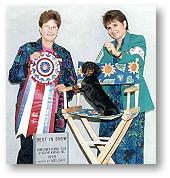 Finally,
at the final level of competition at a dog show, the seven group winners
return to the ring where they compete for BEST IN SHOW, the highest
award at a dog show. The single dog is judged the dog most perfect on that
day by the panel of judges.
Finally,
at the final level of competition at a dog show, the seven group winners
return to the ring where they compete for BEST IN SHOW, the highest
award at a dog show. The single dog is judged the dog most perfect on that
day by the panel of judges.
Points and AKC Championships
While Best in Show is the ultimate goal of every competitor, there are other reasons that dogs are shown at dog shows. Most dogs in competition at conformation shows are competing for points toward their championship. To become a champion (often denoted with a Ch. before the dog's name) takes fifteen points won at the dog show. Of these fifteen, there must be two major wins of three, four or five points. At least three different judges must award the dog points, with the major wins from separate judges, before it can become an AKC "Champion of Record."At one show, a dog may only earn from one to five points towards a champion title. So, no dog can become a champion in less than three shows. The number of points awarded varies from show to show, depending on the number of male or female dogs actually in competition for the breed.
Ribbons at AKC Shows
Each dog that wins or places in their class is given a ribbon by the judge. The color of the ribbon will tell you the type of award the dog has won.- Blue Ribbon - awarded for first place in any regular class (puppy, Bred-by, open, etc). A blue rosette is also awarded for the winner of each group competition, as in a "Group I".
- Red Ribbon - awarded for second place any regular class. A red rosette is also awarded to the second place winner in each group competition (Group II).
- Yellow Ribbon - awarded for third place in any regular class. A yellow rosette is also awarded to the third place winner in each group competition (Group III).
- White - awarded for fourth place in any regular class. A white rosette is also awarded to the fourth place winner in each group competition (Group IV).
- Purple Ribbon - one only awarded to each winner of the Winners Dog and Winners Bitch classes. Since these are the only classes that award points towards a championship, they are very important.
- Purple and White Ribbon - one only awarded to each of the the Reserve Winners, that is, the runners-up in the Winners Dog and Winners Bitch classes.
- Blue and White Ribbon - one only awarded to the dog or bitch which is named Best of Winners, that is the better of the two dogs from the classes: Winners Dog and Winners Bitch.
- Purple and Gold Ribbon - one only awarded in each breed to the dog considered "Best of Breed" in each breed. This is indicates that the dog with the Purple and Gold ribbon is the best of its breed on that day, and will represent the breed in the Group competition.
- Red and White Ribbon - one only awarded in each breed to the dog considered "Best of Opposite Sex" in each breed. This award is given to the best dog in the breed that is the opposite sex of the Best of Breed winner.
- Red, White and Blue Ribbon - only one of these is awarded at the end of each show. It goes to the very last winner at a show, the dog judged to be Best in Show.
Tips If You Are Going To Watch A Show
Buy a show catalog, usually sold at a special table near the entrance to the show. Look for a table marked "Catalogs" or ask at the Superintendents table. This will tell you in which ring and at what time each breed is being judged. It also provides you with information on the owners of the dogs being shown. If you know ahead of time which superintendent is judging the show, you may be able to find the judging schedule on their home page (see list of show superintendents below).Dog shows are busy, noisy and crowded, and people can easily become separated. Pick out in advance a time and place in case anyone gets lost. The Superintendent's booth is a good choice. Be sure if you have short children or adults that you pick a place they can find easily from the floor, or by standing on a chair.
If you are interested in a particular breed, plan to arrive early. Once each breed has been judged, those dogs that did not win are allowed to leave. If you arrive late in the day, you will miss seeing them. Many dog shows are totally over by 3 or 4 pm. Most start at 8 or 9 am. If you do miss the breed judging, you can still (hopefully, if you're not too late) see the judging of the seven groups. The group your breed is in will probably include the Best of Breed winner of your favorite breed. Again, the catalog will have information on the other dogs of the breed that were entered that day.
If you wish to speak with the breeder's/exhibitors of a particular breed it is best to wait and talk with them after they have completed showing. The time before they go in the ring is usually busy and if you wish their full attention its best to wait.
If you are thinking about getting a specific pure-bred dog, talk to the breeders and handlers who have them - they are experts in their breeds and can tell you all you want to know about their breeds. It is always best to approach people at shows after they have shown their dog, when they are not too busy to talk. You might even ask where they are set up for grooming dogs, and talk to them there after they show and take care of their dogs.
NEVER NEVER EVER pet or touch any dog without asking for permission first. The dog may have just been groomed in preparation for being judged, and like people, some dogs may be nervous about going into the show ring. ALWAYS ask for permission before touching anyone's dog.
Many dog shows will have dog-item vendors with unusual and practical dog items for sale. Most will take a local check or credit card. Food at dog shows will depend on the location - if you know what is normally served at the fairgrounds, that's probably what you can get (and how much you'll pay) at the dog show.
Wear comfortable shoes as you will be doing a lot of walking and standing. You may notice many people exhibiting their dogs in comfortable tennis shoes! Unless you bring a chair or arrive early, be prepared to stand to be able to see, as seating usually limited.
If you bring a young child and stroller to a show, please be extremely careful around the dogs. It happens too frequently that someone runs over a dog's tail, or a child reaches to grab or poke the dogs within reach.
Avoid the entrance to the rings, as they get very very congested when the classes change. If you spot someone you would like to speak to, try to keep an eye on them from a distance so that you don' t get into the way. Many handlers show more than one dog in a breed, and they change dogs just outside the ring entrances between classes.
Common Dog Show Terms
AKC - American Kennel Club.Angulation - Angles formed where the bones of a dog meet at the joints.
Bait - Some sort of treat or goodie that is used to keep a dog's attention on the person showing him. Most often used are liver, meatroll slices, hot dogs and small dog biscuits.
Baiting - Using liver or some treat to get the dog's attention and have him look alert.
Bite - The relative position of the upper and lower teeth as seen when the mouth of the dog is closed.
Breeder - Any person who breeds dogs. Also, as defined by the AKC, the breeder of a dog is the owner of the dam of the dog when the dam was bred.
Exhibitor - The person who brings their dog to a show and enters it in the appropriate class.
Fancier - One who is especially interested and usually active in some phase of the sport of pure-bred dogs.
Gait - The way a dog moves - indicating structure and condition of a dog.
Groom - To brush, comb, trim or otherwise make a dog's coat neat and proper as stated in the written Standard of the breed.
Handler - A person or agent of the owner who takes a dog into the show ring or works the dog at a field trial or other performance event for the owner. There are many professional handlers who show dogs at shows.
Junior Showmanship - Classes where the judge awards placements based upon the ability of the handler of the dog. The handlers are between the ages of ten and eighteen years of age.
Match - A relaxed, informal show at which no championship points are awarded but the dogs get the practice of real ring and show conditions.
Parent Club - the national club for the breed (for Maltese this is the American Maltese Association) that represents it to the AKC. Listing of parent clubs may be found on the AKC web page.
Points - Credits earned towards championship status.
Stacking - The process of posing the dog's legs and body to create a pleasing profile.
Winners - An award given at dog shows to the best dog (Winners Dog) and best bitch (Winners Bitch) competing in the regular classes of each breed.
How Can I Find Dog Shows In My Area
There are several ways to find listings of the local shows.- American Kennel Club - The AKC maintains a list of dog shows all over the US.
- InfoDog's Online ShowCalendar - this dog show superintendent has a calendar of upcoming events throughout the US.
Dog Show Superintendents
Show Superintendents (or "supers") are the people who conduct the business end of the shows: they take the entries, set up the rings, assign the judging times, print the catalogs, etc. They are a fountain of knowledge for dog show enthusiasts and they will send out information regarding upcoming shows that they are handling. You can write to the supers (or call them) and ask to be placed onto their mailing lists.Several of the Superintendents are On The Web. You can visit their sites to find to location of upcoming shows in your area.
AKC Superintendents include:
William G. Antypas, P.O. Box 7131, Pasadena, CA 91109Telephone- 818-796-3869 fax - 818-577-2444
http://www.newportdogshows.com
Jack Bradshaw, P.O. Box 7303, Los Angeles, CA 90022
Telephone- 213-727-0136 FAX - 213-727-2949
Margery M. Brown, 2242 London Ave., Redding, CA 96001
Telephone- 916-243-0775
Norman E. Brown, P.O. Box 2566, Spokane, WA 99220
Telephone- 509-924-1089 FAX - 509-924-1421
Helen M. Houser, P.O. Box 420, Quakertown, PA 18951
Telephone-215-538-2032 FAX - 215-376-4939
Ace H. Mathews , P.O. Box 86130, Portland, OR 97286
Telephone-503-233-4241 FAX - 503-233-2306
MBF(Thomas Crowe), P.O. Box 22107, Greensboro, NC 27420
Telephone-910-379-9352 FAX - 910-272-0864
- or -
P.O. Box 9999, Madison Heights, MI 48071
Telephone- 313-588-5000 FAX - 313-588-7380
http://www.infodog.com
Eileen McNulty, 1745 Route 78, Java Center, NY 01482
Telephone-716-457-3371 FAX - 716-457-9533
Jack Onofrio, P.O. Box 25764, Oklahoma City, OK 73125
Telephone-405-427-8181 FAX - 405-427-5241
http://www.onofrio.com/
Bob Peters, P.O. Box 579, Wake Forest, NC 27588
Telephone- 919-556-9516 FAX - 919-554-0519
Robert A. Reed,177 Telegraph Rd., Ste 405, Bellingham,
WA 98226
Telephone-206-738-5502 FAX-206-738-8827
Lewis Roberts, P.O. Box 4658, Federal Way, WA 98023
Telephone-206-547-1982 FAX - 206-952-8059
Kevin B. Rogers, P.O. Box 203, Hattiesburg, MS 39403
Telephone-601-583-1110 FAX-601-582-9909
Elaine Saldivar, 4343 1/2 Burns Ave., Los Angeles, CA
90020
Telephone-213-663-5868 FAX 213-644-1471
Kenneth A. Sleeper, P.O. Box 828, Auburn, IN 46706
Telephone-219-925-0525 FAX 219-925-1146
Nancy Wilson, 8309 E. Camelback Rd., Scottsdale, AZ 85251
Telephone-602-949-5389
Kathleen Zimmerman, P.O. Box 6898, Reading, PA 19610
Telephone-610-376-1880 FAX- 215-376-4939
Have fun and enjoy the shows!
